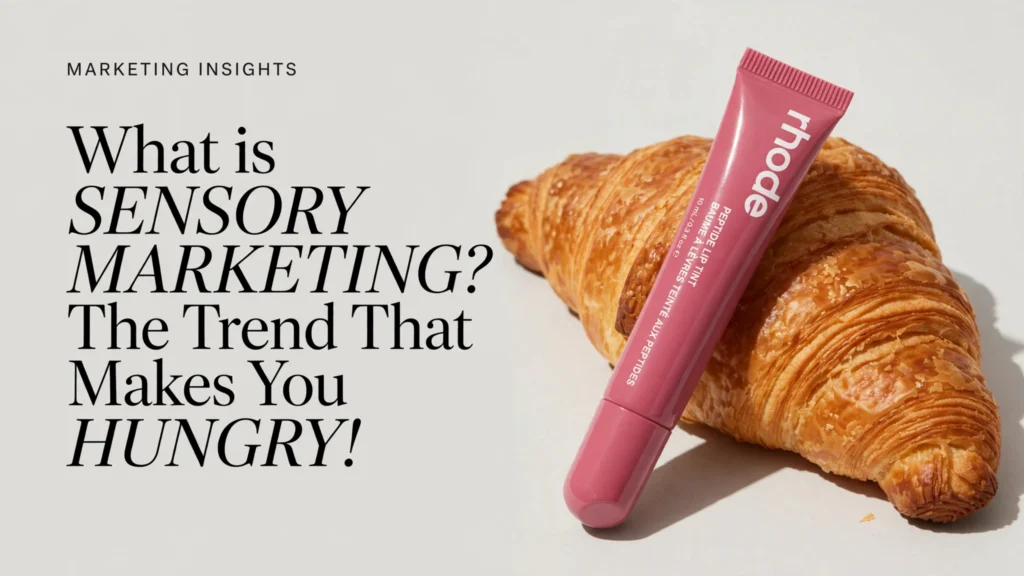
HOW SENSORY MARKETING MAKES YOU CRAVES MORE
Walk past a bakery and your stomach growls before you’ve even seen a croissant. Step into a car showroom and catch that specific “new car” scent, and something in you softens toward the vehicle before the salesperson says a word. None of this is accidental. It’s sensory marketing, and it works because it skips the part of your brain that argues with ads and goes straight for the part that just wants.
YOUR BRAIN DOESN’T JUST BUY PRODUCTS. IT BUYS EXPERIENCES.
Here’s the uncomfortable truth about how people actually make decisions: emotion shows up before reasoning does. Neuroscientists have shown that the brain’s emotional centers process information within milliseconds, while the analytical, “let me think this through” parts lag behind. By the time you consciously register that you like something, your gut has already voted.
Smell has the most direct route of all. Unlike sight or sound, which get filtered through several relay stations before reaching the brain, scent travels almost straight to the amygdala and hippocampus the regions that handle emotion and memory. That’s why a particular smell can drag you back to your grandmother’s kitchen faster than any photograph could. Marketers figured this out long before anyone put a name to it, which is why Cinnabon stores are famously designed with ovens facing the mall corridor, not tucked away in the back. The smell isn’t a byproduct of baking. It’s the ad.
Five Senses, One Goal: Make You Feel Something
Sensory marketing isn’t just about smell, though scent tends to get the spotlight. It’s the whole coordinated effort to make a brand felt, not just seen.
Sound shapes mood more than most people realize. Slow tempo music in a store measurably increases how long shoppers linger and how much they spend a phenomenon retail researchers have documented since the 1980s. Fast, upbeat music does the opposite; it moves people through faster, which is exactly why grocery stores play mellow background music but nightclubs don’t.
Touch builds trust in a way words can’t. This is why premium phone brands care intensely about the weight and texture of a device in your hand, and why luxury packaging uses heavier paper stock than budget brands even when the product inside is identical. Research on the “endowment effect” shows that simply holding an object increases how much value we assign to it touch it, and some part of you already half-owns it.
Sight goes beyond just looking attractive. Color psychology is real, if messier than the infographics suggest red genuinely does raise urgency and appetite (hence fast food branding), blue genuinely does signal calm and trust (hence banks and tech companies). But it’s not just color; it’s also visual rhythm, negative space, and how a product is lit. Apple’s minimalist store lighting isn’t an aesthetic accident it’s engineered to make the products look like objects of desire rather than merchandise.
Taste, obviously central to food and drink brands, has quietly spread elsewhere too. Some airlines have experimented with signature in-flight scents paired with specific in-flight meals to create a taste-memory link that survives long after the flight lands.
Why This Works: The Craving Loop
The real mechanism behind sensory marketing is something behavioral scientists call the craving loop — a cycle of cue, routine, and reward that our brains build almost without our permission. A sensory cue (that bakery smell) triggers a routine (walk in, buy something) that delivers a reward (dopamine hit from the pastry). Do this enough times, and the cue alone starts producing anticipation. You don’t decide to want the croissant. You just find yourself wanting it.
Dopamine, worth clarifying, isn’t actually the “pleasure chemical” people casually call it. It’s the molecule that causes anticipation; it increases prior to the reward rather than during it. This is precisely why the smell of coffee often feels better than the first sip. Brands that master sensory marketing aren’t selling you the product experience; they’re selling you the anticipation of it, over and over, through your nose, ears, and fingertips.
The Ethics Question Nobody Likes to Answer
There’s a legitimate discomfort here worth naming honestly: if a brand can bypass your rational mind and speak directly to your limbic system, is that manipulation or just good design? The honest answer is that it depends on intent and transparency. Using pleasant lighting and a nice scent to make a store feel welcoming is different from artificially pumping in fried-food smell near a display case that’s nowhere near a kitchen, purely to trigger hunger cues disconnected from anything real. One enhances an honest experience; the other manufactures a false one. Consumers are increasingly savvy about this distinction, and brands that lean too hard into manipulation eventually get called out for it which is its own kind of market correction.
What This Means If You're Building a Brand
For anyone running a small business or brand, the takeaway isn’t “install a scent diffuser and hope.” It’s smaller and more achievable: identify the one or two senses your customer actually interacts with, and make those moments intentional rather than accidental. A candle brand should obsess over how the jar feels in hand before it obsesses over Instagram aesthetics. A café should think as hard about ambient sound as it does about its menu design. Sensory consistency the same scent, the same tactile packaging, the same sonic identity across every touchpoint builds recognition faster than logos ever could, because it’s remembered by the body, not just the eye.
The next time you find yourself inexplicably drawn to a store, a product, or a brand you can’t quite explain, it’s worth pausing to ask which sense got there first. Chances are, something touched, smelled, or sounded its way into your decision long before your logic had a say