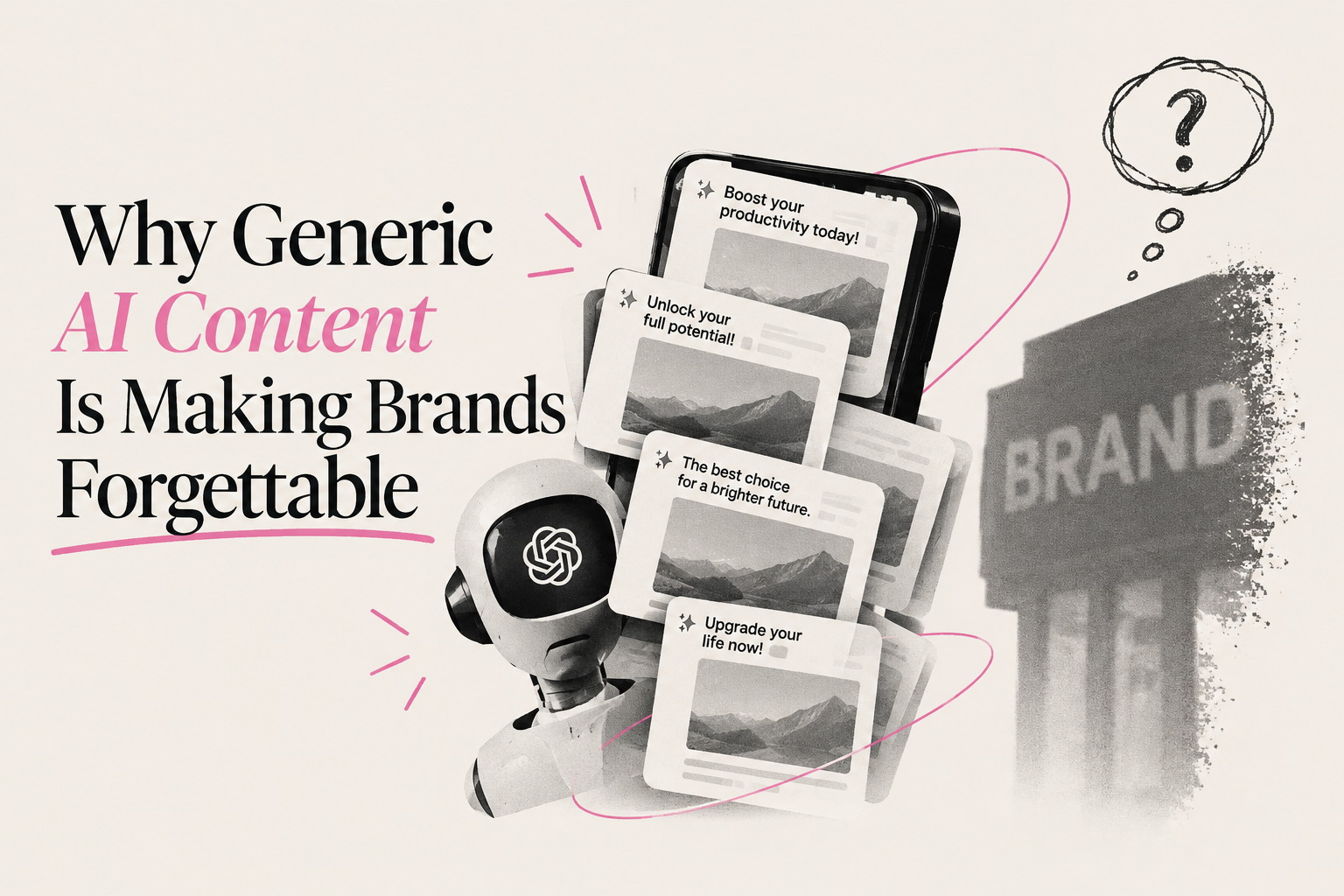
Why Generic AI Content Is Making Brands Forgettable
Scroll through any brand’s Instagram feed today and try to guess which one posted what. Chances are, you can’t. The captions all sound the same. The blog posts all open with “In today’s fast-paced world.” The LinkedIn updates all promise to “unlock your potential” or “take things to the next level.” Swap the logos around, and nobody would notice.
That’s not a coincidence. That’s what happens when hundreds of thousands of brands start typing the same prompt into the same tool and publishing whatever comes out.
Sameness is the new invisibility.
For years, marketers worried about being ignored. Now the bigger risk is being interchangeable. A customer can forget a brand exists even while looking directly at its content, because nothing about it registers as belonging to anyone in particular. It’s not bad. It’s not wrong. It’s just… nothing. And nothing doesn’t get remembered, shared, or trusted.
The Problem Isn’t AI. It’s Laziness Dressed Up as Efficiency
Let’s get one thing straight: AI writing tools aren’t the villain here. Used well, they’re genuinely useful — for outlines, first drafts, brainstorming, cutting research time down from hours to minutes. It becomes problematic when “used well” becomes “used instead of thinking.”
When a brand feeds a vague prompt into a tool and publishes the first output with barely a glance, it’s not creating content — it’s creating filler. And filler has a very specific texture. Even though you couldn’t identify it, you’ve felt it:
Sentences that technically make sense but say nothing
Every paragraph structured like a listicle, even when it isn’t one
A tone so polished it feels like it was run through a corporate translator
Constant use of words like “seamless,” “robust,” “game-changing,” and “elevate”
Conclusions that restate the introduction instead of adding anything new
None of this is offensive. That’s exactly the issue it’s too safe to offend, and too safe to be interesting.
Why This Actually Hurts Brands (Not Just Bores Readers)
It’s tempting to write this off as an aesthetic complaint “the writing feels a bit flat, so what.” But the damage runs deeper than tone.
1. It erodes trust before a single sale happens.
People are getting sharper at spotting AI-generated fluff, and spotting it changes how they read everything else on the page. If the “About Us” section sounds hollow, why would the product claims feel any more credible?
2. It kills differentiation at the exact moment brands need it most.
When ten competitors in the same industry all sound identical, price becomes the only thing left to compete on. That’s a race to the bottom nobody wins except the customer’s wallet — and even that’s temporary.
3. It makes brand voice disappear.
Voice is one of the few things a competitor genuinely cannot copy. A founder’s blunt honesty, a brand’s dry humor, a slightly odd way of explaining things — that’s identity. Generic AI output smooths all of that away in favor of a tone that could belong to anyone, which means it belongs to no one.
4. Search engines and social platforms are catching on too.
Both Google and social algorithms are increasingly built to detect and deprioritize low-effort, mass-produced content. Brands leaning entirely on unedited AI output aren’t just boring humans — they’re quietly getting buried by the systems meant to help them get found.
What Forgettable Content Actually Sounds Like
It’s easier to explain this with a side-by-side.
General: “In today’s competitive market, it’s essential for businesses to leverage innovative solutions to stay ahead of the curve.”
Distinct: “Most businesses aren’t losing to smarter competitors. They’re losing to competitors who bothered to sound like a real person.”
Same basic idea. Completely different amount of memory it leaves behind. The first sentence could open literally any article on any topic. The second one has an opinion, a bit of edge, and a reason to keep reading.
How Brands Get Their Voice Back
The fix isn’t abandoning AI tools — that ship has sailed, and honestly, it should have. The fix is refusing to let AI make the final call.
Start with a real point of view. Before writing anything, ask: what does this brand actually believe that a competitor might disagree with? If the answer is “nothing,” that’s the real problem, and no writing tool will solve it.
Write the ugly first draft yourself, or at least the bones of it. A rough paragraph in a founder’s actual voice, even a messy one, gives an editing tool something worth refining. Starting from a blank prompt gives it nothing to work with but clichés.
Edit out anything that could belong to a competitor. If a sentence would fit just as naturally on a rival’s website with the logo swapped, cut it or rewrite it until it couldn’t.
Bring in the specific stuff AI can’t invent. A customer’s exact words. An internal debate the team actually had. A mistake the brand made and what it learned. These details are what make content feel lived-in instead of generated.
Read it out loud before publishing. If it sounds like it’s being read by a newscaster instead of said by a person, it needs another pass.
The Real Opportunity
Here’s the part that should feel encouraging rather than discouraging: because so many brands are currently pumping out the same flavorless content, the bar for standing out has actually dropped. It doesn’t take a massive budget or a viral stroke of genius to be memorable right now — it just takes sounding like an actual, specific brand with an actual, specific voice, at a moment when almost nobody else is bothering to.
The brands that will be remembered five years from now aren’t the ones that used AI the most. They’re the ones that used it the least carelessly — as a tool that supported a real voice, instead of a replacement for having one at all.
Being forgettable used to require doing something wrong. Now, it just requires doing what everyone else is already doing. The opposite of forgettable was never “louder” or “more polished.” It’s just being unmistakably yourself.